Have you ever tried to clean a land full of roots, logs, demolition debris, or mixed waste… using just a normal bucket?
Does it work? Yes. Is it efficient? We have doubts. In this article, we will try to explain why!
You will learn about the rake bucket with grapple and why it might be the perfect solution.
This accessory was designed for situations where just digging is not enough. You need to separate, grab, lift, and move materials in a controlled way. And when the land is full of irregular debris, logs, stones, or construction waste, having a hydraulic grapple makes all the difference.
If you work in:
- Land clearing;
- Brush removal;
- Waste sorting;
- Forest maintenance;
- Light demolitions;
Then this could be the accessory that simplifies your work.
But when is it worth using? Is it better than a simple rake? And how do you know which model is right for your machine?
Throughout this article, we will answer these questions clearly and practically, so you can understand if the rake bucket with grapple is the ally your operation needs.
What is a Rake Bucket with Grapple?
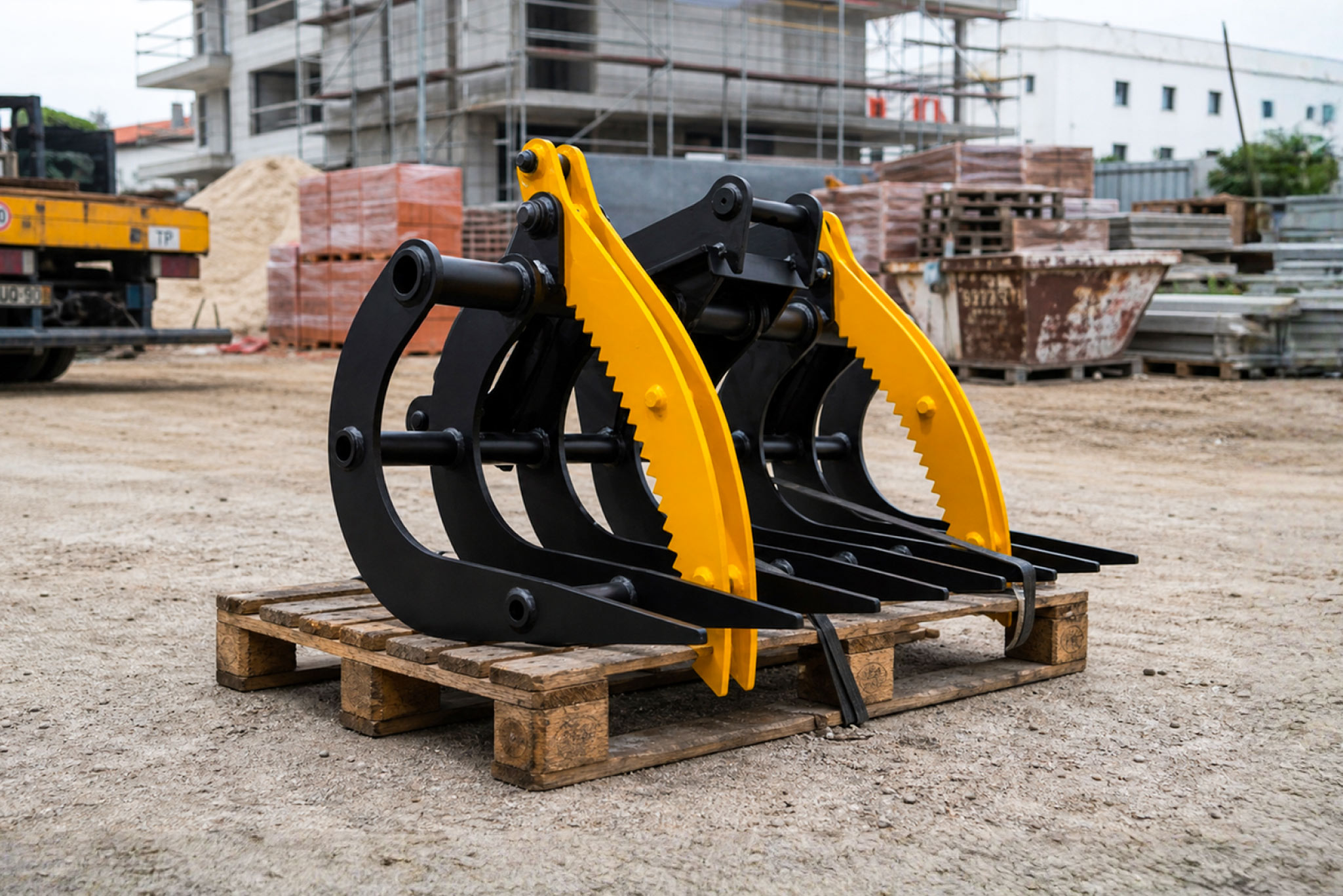
A rake bucket with grapple is an excavator accessory that combines rake-like teeth with an upper hydraulic grapple, allowing you to grab, separate, and move materials in a controlled manner.
Now, translating this to the field: imagine a robust rake, but instead of just dragging materials, it has a hydraulic grapple that closes on top and secures what you are moving.
Its structure works like a reinforced grid. The teeth are spaced, allowing soil to separate from roots, letting finer materials fall, and retaining only the larger debris.
On top, the hydraulic grapple comes into action. It allows you to grab logs, stones, demolition debris, or irregular waste and keep them fixed during transport.
In other words, it does not just drag materials; it controls them.
This type of equipment is normally used on excavators but can be adapted to different compatible machines, as long as there is a suitable hydraulic connection to power the grapple.
In practice, it transforms the machine into a much more versatile tool when the job requires precision, separation, and control.
What is a Rake Bucket with Grapple Used For?
The rake bucket with grapple is used to grab, separate, and move irregular materials in a controlled way, especially in tasks where just digging is not enough.
It is particularly useful when the goal is not to remove clean soil but to handle mixed debris, roots, logs, or construction waste.
In practice, it is used in:
- Land Clearing
After brush removal or soil preparation, it allows collecting roots, stones, and larger debris, leaving the soil cleaner.
- Root Removal
The rake-like teeth help loosen roots from the soil, while the hydraulic grapple allows grabbing and removing them with control.
- Waste Separation
Thanks to the grid structure, soil and finer materials pass through the teeth, retaining only the larger debris.
- Material Sorting
Very useful in recycling or demolition contexts, where it is necessary to separate wood, metal, or rubble.
- Moving Logs and Forest Debris
The grapple allows grabbing logs and branches safely, facilitating transport and organization of the material.
- Light Demolitions
In small demolition tasks, it helps collect and separate debris more efficiently.
Advantages of a Rake Bucket with Grapple
If you have worked with irregular materials, you know the biggest challenge is not moving the soil, but controlling what you are moving.
This is where the rake bucket with grapple stands out.
✔ Greater control during movement
The combination of rake-like teeth and hydraulic grapple allows holding the material during transport, preventing falls or unwanted shifts.
✔ Ability to grab and secure materials
Unlike a simple rake, the grapple closes over the material and keeps it secured, whether it is a log, root, or piece of debris.
✔ Ability to grab and secure materials
The grid structure lets soil and finer materials pass, retaining only what truly needs to be removed.
✔ Reduced rework
Fewer material drops and greater precision mean less need to repeat movements.
✔ Increased productivity
Allows performing multiple operations in a single pass: separate, grab, and transport.
✔ Safer handling of irregular loads
Securing the material reduces the risk of unexpected movements, making the operation more stable and controlled.
Difference Between a Simple Rake Bucket and a Rake Bucket with Grapple
At first glance, they may seem similar, but in practice, they serve different functions.
Simple Rake Bucket: composed only of spaced teeth, functioning like a grid.
It is mainly used to:
- Drag materials;
- Separate soil from debris;
- Remove surface roots;
- Lightly clean the land.
It is an effective solution when the main goal is just to separate and organize materials on the ground.
Rake Bucket with Grapple: besides the rake-like teeth, it integrates an upper hydraulic grapple.
This allows:
- Grabbing materials;
- Lifting irregular loads;
- Transporting debris with control;
- Securing logs, roots, or rubble.
In other words, it not only separates. It also allows safe handling and moving of the material.
Which is Better for Land Clearing?
It depends on the type of work.
If the goal is only to remove light debris and level the land, the simple rake may be sufficient.
But if you need to grab, lift, and transport logs, roots, or irregular materials, the rake bucket with grapple offers much more control and efficiency.
Ultimately, the difference is in handling capacity. With a grapple, you gain control. Without it, you are limited to separation.
How to Choose the Right Rake Bucket with Grapple
Choosing the right model is not just a matter of price or size. To ensure safety, performance, and durability, some key factors must be considered:
✔ Machine weight
The bucket must be correctly sized for the excavator. An overweight model may compromise stability and performance, while an undersized model may limit work capacity. Balancing machine weight and accessory weight is essential.
✔ Accessory width
The bucket width directly affects the area covered in each pass. For larger and open terrains, wider models increase efficiency and reduce the number of passes needed. In tighter spaces or precise tasks, a narrower width improves control and maneuverability.
✔ Type of material to handle
Will you work with:
- Roots and logs?
- Mixed debris?
- Demolition rubble?
Heavier or irregular materials require more robust structures and a grapple with good gripping capacity.
✔ Intensity of use
Occasional use does not demand the same robustness as daily intensive use.
If the equipment will work every day, choose a solution designed for constant wear.
✔ Compatible hydraulic system
Without this technical check, the grapple may not work as expected, compromising performance or even safety.
Where to Find Quality Rake Buckets with Grapple
If you are looking for a robust, reliable solution ready for demanding work, it is crucial to choose proven quality equipment.
At Camponesa, you will find rake buckets with grapple designed for durability, control, and performance in real-world construction, forest clearing, or material sorting.
They are robust solutions, compatible with different machines, and prepared to meet the demands of intensive fieldwork. Each model is designed to provide safety, efficiency, and durability, even in the most demanding operations.
If you need to separate, grab, and move materials with greater precision and confidence, check the available range and find the rake bucket with grapple most suitable for your machine and type of work.
Frequently Asked Questions
Is the rake bucket with grapple suitable for root removal?
Yes. It is especially effective for removing roots and plant debris. The teeth help loosen material from the soil, and the grapple allows controlled transport.
Can it be used in demolition?
Yes, mainly in light demolitions or material separation tasks. It allows moving rubble, wood, or mixed debris more efficiently.
What maintenance is required?
Regularly check the hydraulic system, grapple joints, and structural condition of the teeth. Simple preventive maintenance ensures continuous performance and longer durability.
Is the grapple hydraulic or mechanical?
Most models feature a hydraulic grapple, powered by the machine’s hydraulic system, allowing better control and gripping force during material handling.
Is it worth it for occasional use?
It depends on the type of work. If even occasional use involves separating and grabbing irregular materials, it can be a worthwhile investment. For very occasional and simple tasks, a rake without a grapple may suffice.
Is it suitable for forest work?
Yes. It is widely used for forest clearing, organizing logs, and removing plant debris after brush removal.
Does it increase productivity?
Yes. By allowing separation, grabbing, and transport in a single operation, it reduces unnecessary movements and improves efficiency on-site.
Can it be used on sloped terrain?
Yes, as long as the machine is properly positioned and the equipment correctly sized. The hydraulic control helps stabilize the load during movement.
What precautions should be taken when handling irregular loads?
Do not exceed the machine’s capacity, ensure the grapple is fully closed, and always keep the material close to the ground for greater stability.
A tool for every job.