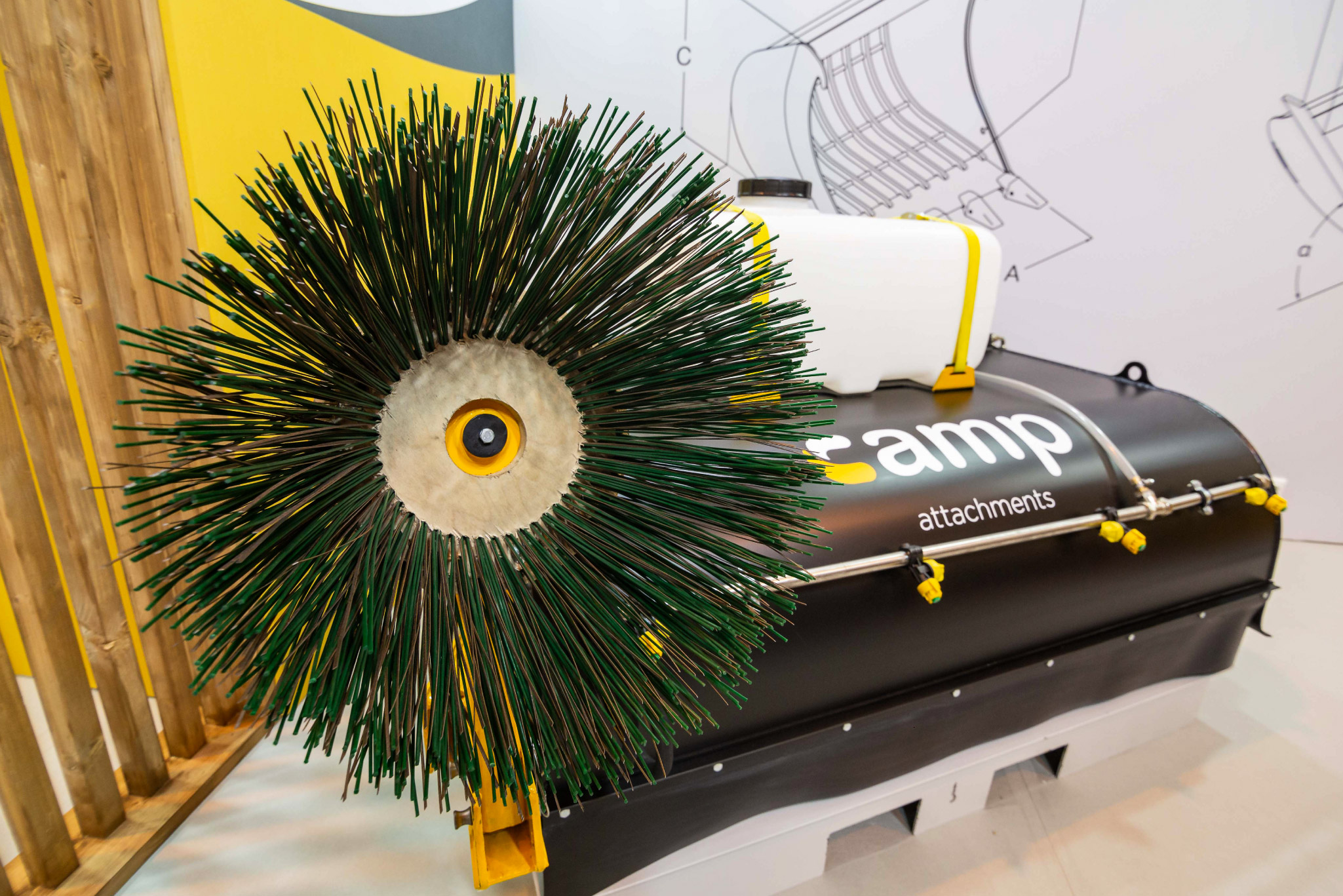
When cleaning public roads, parking areas or industrial floors, removing soil, dust and debris can be a slow process, especially when the equipment used is not the most suitable.
This is where the hydraulic broom bucket makes all the difference.
This attachment allows you to sweep and collect debris in a single operation. Instead of sweeping first and collecting afterwards, it performs both actions at the same time. The result? Faster work, less effort and greater efficiency on the ground.
Widely used by paving companies, maintenance teams and recycling facilities, the hydraulic broom bucket adapts to different working environments and makes it easier to clean large surfaces with control and safety.
But how do you choose the model that best fits your machine?
In this article, we clearly explain what you should consider before making your decision.
What is a hydraulic broom bucket?
A hydraulic broom bucket is an attachment for skid steers, loaders, backhoe loaders, telehandlers or articulated loaders that allows sweeping and collecting debris mechanically.
Unlike a simple broom, this equipment integrates a hydraulic system that rotates the brushes and directs debris into a rear collection bucket. This allows continuous and controlled cleaning.
How it works is simple:
- The machine moves forward
- The polypropylene brushes rotate through the hydraulic system
- The swept material is directed into the bucket
- At the end, the collected debris is simply emptied
Some models can also be equipped with a side broom to increase the cleaning width, and a water system to reduce dust during operation.
What is it used for?
This equipment is used whenever surfaces need to be cleaned quickly, uniformly and with immediate debris collection.
It is commonly used in:
- Public roads
- Parking areas
- Industrial floors
- Warehouses
- Paving works
- Recycling and maintenance areas
It removes soil, sand, fine dust, paving residues and accumulated debris, keeping the area clean and safe for circulation.
What are the advantages of using a hydraulic broom bucket?
Compared to traditional cleaning methods or manual sweeping, the hydraulic broom bucket offers clear advantages.
✓ Cost reduction
By sweeping and collecting debris in a single operation, it reduces the need for additional labour and eliminates intermediate steps. Fewer resources involved means lower overall intervention costs.
✓ Higher productivity and efficiency
It allows large areas to be cleaned continuously and efficiently. The machine performs more work in the same amount of time, without constant interruptions.
✓ Shorter execution time
Cleaning large surfaces becomes faster and more uniform, especially in parking areas, industrial floors or construction zones.
✓ Increased safety
Equipped with front and side rubber protection, it helps prevent material projection during sweeping, reducing risks for people in the work area.
✓ Reduced wear and maintenance
By collecting debris directly, it prevents excessive accumulation on the ground and reduces repetitive strain on the machine, contributing to more controlled operation.
In professional environments, these advantages translate into less downtime, better workspace organisation and greater control over the final result.
How to choose the ideal hydraulic broom bucket
Before choosing, ask yourself: “What do I really need this equipment for?”
There is no “best” model for everyone. There is the right model for your job.
Let’s break it down:
Where will you be working?
- Public roads
- Parking areas
- Industrial floors
- Dusty construction sites
If you work in very dusty areas, a model with a water system may be the best option. If you need to reach corners and side areas, a hydraulic side broom can make a big difference.
What type of debris will you remove?
Is it sand and fine dust? Or heavier debris, such as paving residues?
Polypropylene brushes are resistant, but the type of work influences the required robustness and frequency of replacement.
Is your machine compatible?
No improvisation here. Check:
- Available hydraulic flow
- Attachment type
- Machine load capacity
A poorly sized bucket can compromise performance or, worse, safety.
What is the ideal width?
The wider the bucket, the larger the area cleaned per pass. But be careful: excessive width on a small machine can affect stability.
Balance is key.
Will you use the equipment daily?
For intensive use, choose a robust model designed for continuous operation. For occasional use, a simpler solution may be enough.
In short, choosing the right hydraulic broom bucket means aligning three things:
✔ Type of work
✔ Machine compatibility
✔ Frequency of use
When these three points are aligned, the result is simple: you work better, faster and with fewer complications.
How to maintain a hydraulic broom bucket
Like any work equipment, a hydraulic broom bucket requires basic care to keep functioning properly and avoid unexpected downtime.
The good news? Maintenance is simple, as long as it is regular.
✓ Check the hydraulic system
Look for oil leaks, damaged hoses or loose connections. A healthy hydraulic system ensures efficient brush rotation and safe operation.
✓ Replace brushes when worn
Polypropylene brushes are durable, but they wear over time. If sweeping efficiency decreases, it may be time to replace them.
✓ Clean the water system (if applicable)
If the model includes a water system for dust control, keep tanks and nozzles clean to avoid blockages.
✓ Inspect check valves
Regularly ensure that the check valve is functioning correctly to prevent unwanted hydraulic flow.
Small regular checks prevent major problems later.
In summary: is it worth investing in a hydraulic broom bucket?
If you regularly work in cleaning public roads, industrial floors or construction sites, the answer is simple: yes.
A hydraulic broom bucket allows you to:
✔ Sweep and collect debris in a single operation
✔ Reduce intervention time
✔ Work with greater control and safety
✔ Increase machine efficiency
In practice, this means higher productivity, better cleaning quality and reduced operational effort.
When properly chosen and well maintained, it becomes a reliable piece of equipment with low long‑term operating costs and excellent return for professionals who need consistent results on the ground.
Where can you find high‑quality hydraulic broom buckets?
At Camponesa, you will find front broom buckets for skid steers designed to meet the demands of construction, industry and urban maintenance.
With a hydraulic motor directly connected to the roller, wear‑resistant materials and optional accessories, these solutions are designed to maximise operational efficiency.
Explore the available range and find the model that best suits your project.
Frequently Asked Questions
Can a hydraulic bucket broom be used on all types of surfaces?
Yes. It can be used on asphalt, concrete, and industrial floors. The important thing is to match the equipment to the type of debris being removed.
Can you work in reverse?
Yes. Most models allow operation both forward and backward, which makes cleaning easier in confined spaces.
Is the water system really worth it?
If you work in very dusty environments, yes. It reduces airborne particles and improves working conditions.
Do the brushes need to be replaced?
Yes. They wear out over time. Replacement is simple and ensures optimal performance.
Can it be used in industrial environments?
Yes. It is widely used in warehouses, factories, and logistics areas.
Does the bucket broom create a lot of dust?
It depends on the type of debris and the condition of the floor. For very dusty work, a model with a water system is recommended.
Which machines can use a hydraulic bucket broom?
Skid‑steer loaders, backhoe loaders, and wheel loaders, as long as hydraulic compatibility is ensured.
Can it collect stones and heavier debris?
Yes, as long as they remain within the equipment’s capacity. Choosing the right model is important.
What is the difference between a bucket broom and a simple hydraulic broom?
The bucket broom includes a collection system. The simple broom only pushes debris aside.
Does it replace manual cleaning?
On large surfaces, yes. It significantly reduces the need for manual sweeping.
Is it easy to empty the collected debris?
Yes. The system allows for quick and easy dumping.