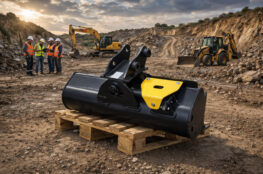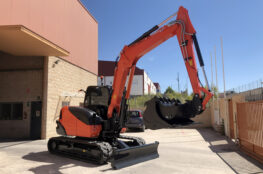
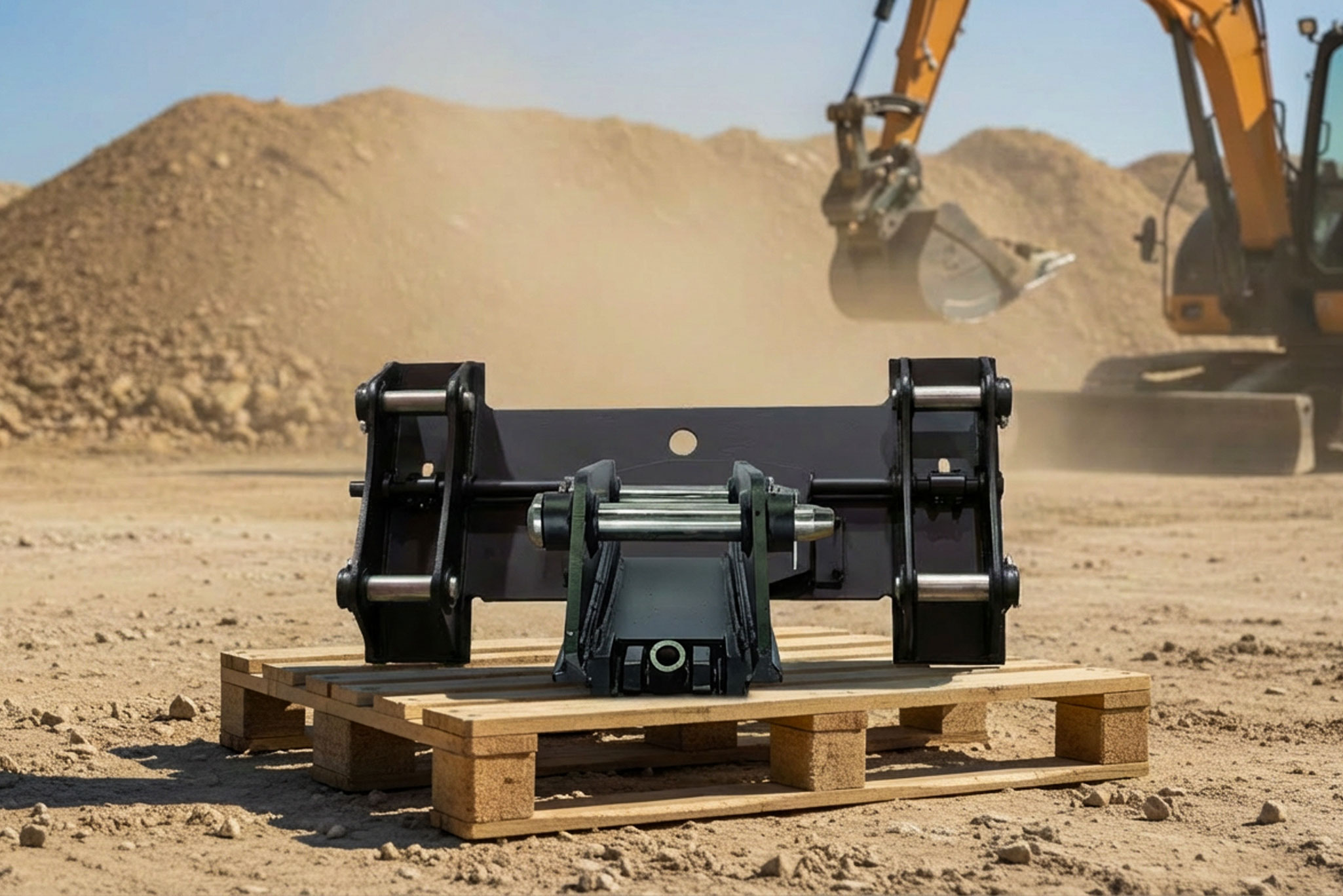
The choice of the most suitable quick coupler depends on the type of machine, the frequency of accessory changes and the specific requirements of each job site. Quick couplers can be mechanical, hydraulic or hybrid.
Mechanical quick coupler
The mechanical quick coupler is a simple, reliable and widely used solution. Accessories are changed manually using a spring and pin system, allowing the attachment to be released and secured more quickly when compared to traditional systems without a coupler.
This type of coupler stands out for its robustness and ease of maintenance. It does not require connection to the machine’s hydraulic system, making it a practical option for equipment where accessory changes are not frequent.
It is especially suitable for:
- Job sites with a lower frequency of attachment changes;
- Operators who prioritise simplicity and reliability;
- Machines without hydraulic preparation for automatic couplers.
Hydraulic quick coupler
The hydraulic quick coupler was developed for situations where accessories are changed frequently and time is a critical factor. In this system, the release and locking of the attachment are carried out through the machine’s hydraulic circuit, allowing the operator to perform the change directly from the cab.
This solution offers greater comfort, speed and operational efficiency, further reducing machine downtime and minimising physical effort for the operator. It is particularly advantageous in intensive working environments, where different attachments are used several times throughout the day.
It is especially suitable for:
- Job sites with a high rotation of attachments;
- Operations that require maximum productivity;
- Machines prepared for hydraulic integration
Hybrid quick coupler
The hybrid quick coupler emerges as a solution for situations in which a company wishes to keep its existing attachments, even after acquiring a new backhoe loader or mini excavator with different specifications.
This type of coupler allows the new machine to be adapted to older attachments, avoiding immediate investment in new accessories. It is an economical and technical solution, developed to measure, requiring precision in manufacturing and in-depth knowledge of the original equipment dimensions.
Hybrid couplers are manufactured specifically for each case, ensuring compatibility, safety and performance without compromising the integrity of existing attachments.
If you would like to explore this topic further and learn how to choose a quick coupler for your mini excavator, read our dedicated blog article.
How coupler types influence attachment compatibility
Attachment incompatibility is a structural issue in the mini excavator and backhoe loader sector, caused by the lack of a universal coupler standard. Although it may seem logical that buckets, rippers or other attachments could be interchangeable between brands, in practice this rarely happens without technical adaptations.
Each manufacturer designs its machines with specific dimensions, such as pin diameter, centre distances and arm width. These differences result from decades of independent development, proprietary technical solutions and commercial strategies focused on dedicated systems.
Machines without a quick coupler system: limited compatibility
On machines without a quick coupler, attachments are usually dedicated to a specific model, with fixed pins and dimensions. As a result, compatibility between brands is very limited, attachment changes are slow, reusing implements is difficult and any modification requires direct adaptations to the attachment, which are not always technically or economically viable.
Mechanical, hydraulic or hybrid quick couplers: greater versatility and autonomy
Quick couplers are the solution when incompatibility exists between machines and attachments. They act as a transition element, allowing old attachments to be used on a new machine, enabling compatibility between different coupler standards and avoiding the complete replacement of the attachment fleet.
This type of solution requires custom manufacturing and specialised technical expertise, ensuring correct fitment, high safety levels and reliable performance on site.
Before making a decision, it is essential to carefully analyse the available options, assess the type of work carried out and consult specialists and trusted suppliers in order to maximise the potential of your mini excavator for each task.
For technical support or clarification of any questions, Camponesa provides technical solutions developed to measure for each machine and application.
A tool for every job
FAQs
Does the type of coupler influence attachment compatibility?
Yes. The type of coupler directly influences compatibility, as it defines the dimensions and coupling standard of the attachments.
Does a quick coupler make all attachments compatible?
No. A quick coupler only guarantees compatibility within the same coupler system. Attachments with different standards may require technical adaptation.
What is the best coupler for those who already have several attachments?
It depends on the situation. In many cases, hybrid couplers or custom-made solutions allow existing attachments to be retained without the need for replacement.
Is it worth adapting the coupler instead of the attachments?
In most cases, yes. Adapting the coupler is generally more efficient, safer and more economical than replacing the entire set of attachments.
Do quick couplers increase job site safety?
Yes. When correctly sized and installed, quick couplers increase safety by ensuring proper engagement and reducing errors during attachment changes.